Latest EHE News, Events & Research

One in a Million: Robbie Garrovillas’ Journey of Diagnosis, Treatment, and Faith When Robbie Garrovillas received his EHE diagnosis in 2025 and endured nine grueling cycles of chemotherapy, he faced not just a medical crisis, but an existential one. How do you make sense of a rare cancer that refuses to fit into neat categories? […]

For a cancer as rare as EHE, connection is something we intentionally create. On Saturday, April 11, 2026, EHE Foundation and Dana-Farber Cancer Institute hosted an inaugural EHE Education Day, bringing together patients, loved ones, clinicians, researchers, and advocates for a day of learning, discussion, and in-person connection. With more than 25 people in attendance, […]

Lila’s Story: Finding Strength in the Unexpected Lila’s EHE story began in a way no one could have planned. Her aunt, an ultrasound technician, was casually scanning her one day when she noticed something unusual on Lila’s liver. What seemed like an offhand moment quickly became something much more serious. “She instantly found 1-2 spots […]

Farzaad’s Story: Facing EHE with Faith, Strength, and Positivity For Farzaad, the first signs that something was wrong were easy to notice, but impossible to explain. Around May 2025, he began experiencing swelling in his face that did not feel normal. He also found himself becoming short of breath more easily. Over time, other changes […]
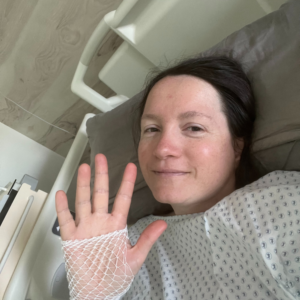
Anke’s Story: Building Knowledge and Choosing to Just Live For Anke, the road to an EHE diagnosis began with something deceptively ordinary: a stomach ache. Her doctor, being extra cautious, ordered an ultrasound. The scan showed shadows on her liver, and what followed were eight long weeks of uncertainty, testing, and waiting. When the pathology […]

Colton’s Story: Fighting EHE with Strength, Hope, and Connection From the very beginning, Colton’s life was marked by resilience. He and his twin brother, Bryson, were born seven weeks early on August 13, 2012. After spending a month in the NICU, Colton faced another serious hurdle at just seven weeks old, when he was admitted […]

Cato’s Story: Learning to Live in the Present For Cato, the beginning of her EHE story did not come with dramatic symptoms or a clear warning sign. It began quietly, almost invisibly, with fatigue and a routine blood test that seemed, at first, to lead to something minor. That first test showed abnormal liver values […]
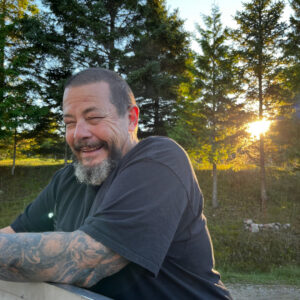
Norm’s Story: A Family’s Love, Search for Answers, and Life After Loss When Norm went in for a routine health appointment in late 2022, neither he nor his family imagined how quickly life was about to change. A chest X-ray revealed something concerning in his right lung. Until then, Norm had only noticed what felt […]
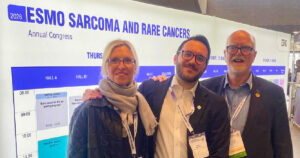
In March, EHE Foundation was represented at two important meetings in Europe focused on sarcoma, rare cancers, and EHE research. These gatherings were invaluable opportunities to connect with clinicians, researchers, and fellow advocates working to improve care, deepen understanding, and advance progress for people affected by EHE. Executive Director Denise Robinson attended on behalf of […]
Following the publication of results from a phase 2 study of eribulin in two vascular sarcomas, angiosarcoma and EHE, Dr. Tom Chen of National Taiwan University College of Medicine shared commentary in Clinical Cancer Research. He praised the investigators for their collaborative study while also pointing to important considerations for future research. Although angiosarcoma and […]