
EHE Global Patient Registry
Patients Powering Research for Epithelioid Hemangioendothelioma
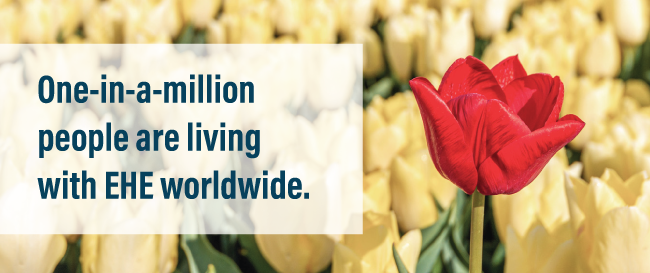
The EHE Global Patient Registry empowers people with Epithelioid Hemangioendothelioma (EHE) to join together to improve our understanding of this ultra-rare sarcoma.
Together, we will advance research to ultimately find effective treatments and a cure for EHE. This registry aims to create a large, global, long-term database and resource about EHE. EHE is incredibly rare, so it is important that as many people as possible join the registry. People who have been diagnosed with EHE (or their legal adult representative) from anywhere in the world are encouraged to join and describe their experience with EHE over time. The registry is hosted by the National Organization for Rare Disorders (NORD®) on their IAMRARE® platform.
Download Patient Registry Flyer
For questions, please email [email protected].
Download the IAMRARE Mobile App
Help advance EHE research, whenever, wherever.
The IAMRARE mobile app is available from the Apple Store and Google Play. Download today!
Tip: Sign up via desktop first, then log in using the mobile app.
EHE Global Patient Registry
Frequently Asked Questions (FAQs)
Below are some of the frequently asked questions to help you learn more about the EHE Global Patient Registry. If you have further questions, contact us at [email protected].
A patient registry is a collection of standardized information about a group of patients who share a condition. The information may be used for a variety of purposes such as conducting natural history studies and supporting disease specific clinical trial recruitment.
The purpose of the EHE Global Patient Registry is to bring the EHE community together and collect data from patients to advance collective knowledge about EHE. The registry has been created with the intent to develop a large, global and long-term database and resource on this rare cancer. The EHE Foundation invites people with EHE from around the world to contribute their information and help advance EHE research. Data compiled in the registry aims to answer important questions, allow a better understanding of EHE, and potentially identify new research opportunities.
The registry has the following goals:
- To describe the people who have EHE and to better understand the variability and stages of EHE
- To understand how EHE changes over a person’s lifetime
- To learn about clinical practice patterns and variations in the management of EHE
- Help identify hospitals and doctors who are treating people with EHE so that we can provide a resource for new patients with EHE
- To identify people with EHE who might be willing to take part in other research studies or clinical trials
- To support the development of, or collaboration with, other EHE or relevant disease databases to advance research
- Educate the EHE community of various aspects of EHE disease presentation and utilized treatment modalities
- To help to develop best practices, management guidelines, and recommendations so that clinicians can know how to give the best care to improve the quality of life and treatment outcomes for people with EHE
- To empower and advocate for expanded insurance coverages and to assist the EHE community with the development of recommendations and standards of care
A natural history study is a study designed to track the course of a disease over time. It includes people who have a specific medical condition or disease. It may also include those who are at risk of developing the condition/disease. This type of research identifies demographic, genetic, environmental, and other information that may be common within the disease and its outcomes. A natural history study can also show the differences in symptoms and changes over time that are seen in different people with the same disease.
Data in the EHE Global Patient Registry is collected through a secure web-based application (that can be accessed by computer, tablet, or phone) developed by the National Organization for Rare Disorders, Inc. (NORD®), (learn more about NORD in question 24). Study participants respond to questions grouped within a series of surveys.
The data collected includes but is not limited to:
- Socio-demographics
- Medical and diagnostics
- Treatment and disease progression
- Management of care
- Quality of life
The EHE Global Patient Registry is being sponsored and conducted by The EHE Foundation. A research study sponsor is an individual, company, institution, or organization responsible for assigning appropriately trained and experienced researchers and staff to conduct a study. The sponsor is also responsible for the initiation and management of this registry, as well as any costs associated with the registry. As the sponsor, The EHE Foundation’s responsibility is to ensure that this registry is conducted in a reputable, ethical manner and upholds regulations as they apply to this research.
The EHE Foundation is a non-profit 501(c)(3) organization whose mission is to seek effective treatments and a cure for the rare cancer, Epithelioid Hemangioendothelioma (EHE), by advancing research and driving collaboration between patient, researcher, and clinicians.
The Principal Investigator (PI) is the person with the primary responsibility for the design and conduct of the research project or study. The PI is responsible for oversight of all aspects pertaining to the conduct of the Registry, its staff, and the research on the data contained within.
A Study Participant is the individual about whom information is entered into the registry. Participants in this registry can be of any age. Additionally, deceased persons may be included in the registry.
In the case of a person of legal age (usually 18 years or older), this individual will provide Informed Consent for and enter information about themselves in the registry. If an individual is not of legal age or is an adult who requires someone to act on their behalf, a person (Caregiver/LAR, see below) who is legally responsible for their health care will provide consent and enter information about the Study Participant.
An LAR is someone who is authorized under applicable law to consent and enter data in the registry on behalf of another individual. The LAR may be a parent, grandparent, spouse, caregiver, child, sibling or guardian as long as they have the legal authority to grant consent on behalf of that individual. An LAR will sign up on the IAMRARE platform with a Caregiver account. When an LAR acts on behalf of a study participant, they are considered to be the reporter in the research.
An ICF is a document that provides potential participants with key information about the registry. This document helps potential participants to make a voluntary decision whether to join or not. Information will include topics such as: the risks and benefits of the research project, use of data, and participant privacy. If they choose to join the study, participants are required to electronically sign the ICF. This indicates that they agree to the terms as described before entering data into the registry or responding to surveys.
The Informed Consent Form is available upon request for review. Please email [email protected] to request the appropriate Consent form by telling us if you are an adult over the age of 18 consenting for yourself, a legally authorized representative consenting for a person under the age of 18 or an adult who cannot consent his/herself, or a designated representative of someone who is deceased.
Participants are able to stop participating and withdraw from the registry at any time. However, researchers may still use the information that they have collected prior to the participant changing their mind. Information that has already been shared with researchers prior to withdrawal cannot be retrieved or removed.
An IRB is a board formally designated by an institution or investigator to review, approve the initiation of, and conduct periodic review of research involving people. The primary purpose of such an assessment is to assure the protection of the rights and welfare of the participants in the study. This is also known as an Ethics Committee (EC) or Research Ethics Board (REB in Canada).
This study is open to anyone who has been diagnosed with epithelioid hemangioendothelioma (EHE) and meets the study inclusion criteria for participation.
There is no cost to the patient to join this registry.
Registry participants will not be paid for the information they provide.
A registry on the IAMRARE platform will typically be open for at least five years. Participants will be asked to return to the registry periodically to update their information.
The registry uses an online platform which allows participants to contribute data from anywhere in the world. Individuals from other countries who enter data into the registry should be aware that data and privacy laws are different in the U.S. from other countries. This U.S. based registry will protect data and privacy according to U.S. requirements. Servers are compliant with U.S. and international regulations, including General Data Protection Regulation (GDPR). This Registry will be conducted in accordance with all regional, national, and international laws, as applicable.
The data is stored on NORD’s secure registry platform system, which adheres to industry standards regarding security protections.
The registry follows strict government guidelines to assure patient information is protected. The platform is served over HTTPS, which means that the data is encrypted when being sent from the user’s browser to the NORD servers. The data is also kept encrypted in the NORD database. Communications between the registry platform application server and the database are also encrypted. As with any information you provide electronically, there is a very rare chance that your privacy could be compromised. However, the registry and the security measures minimize the chance of this occurring.
The study data are owned by the study sponsor, The EHE Foundation. The EHE Foundation together with the Registry Advisory Board decides how and with whom to share de-identified data. NORD staff will have access to the data for activities related to support and maintenance of the IAMRARE Registry Platform and will collect Platform-wide participation statistics. More detail is outlined in the informed consent.
The registry is maintained by NORD who hosts the registry on its web-based application. NORD provides ongoing technical support of the system. The EHE Foundation provides the day-to-day management of the patient registry.
A Registry Advisory Board is a committee that may include scientists, doctors, and patient advocates. They oversee the conduct of the study. The board advises on the development of surveys and reviews combined registry data and the use of this registry. They will ensure proper evaluation of all research requests for use of the registry data. They will also review any protocol or confidentiality deviations and ensure that any such deviations are reported to the IRB.
NORD, an independent nonprofit, is leading the fight to improve the lives of rare disease patients and families. They do this by supporting the rare community, its people, and organizations. They work together to accelerate research, raise awareness, provide valuable information, and drive public policy that benefits the estimated 25-30 million Americans impacted by rare diseases. Learn more about NORD at https://rarediseases.org/.
Stay Informed
Quarterly newsletters to the EHE Collaborative Research Network (EHE CRN) provide firsthand information about our research program, advances in EHE research, and opportunities to collaborate with our professional and patient communities.