
We envision a world where Epithelioid Hemangioendothelioma (EHE) is easily diagnosed and treatable. Join our dedicated community by subscribing to our emails.

The EHE Foundation invests in innovative science and discovery that aims to find better treatments and a cure for EHE. These investments enable collaboration across diseases and scientific domains. See how the EHE Foundation advances EHE research by supporting scientists attending the YAP/TAZ and TEAD: At the Crossroads of Cancer workshop in Telluride, CO.
A short film produced, directed, and edited by Joy Weinberg.

EMPOWER YOURSELF WITH KNOWLEDGE
Upcoming Foundation Events
Quick Links
Patients
Community
Latest EHE News, Events and Research

Science Saturday: EHE Research Progress & Momentum
Join the EHE Foundation for a special Science Saturday on Rare Disease Day, February 28, 2026, 11:00 am – 12:30 pm ET. This virtual event is designed for anyone affected by EHE who wants an up-to-date view of the EHE research landscape. This free, interactive presentation will highlight Foundation-led research, global scientific advances, and the […]
Reflecting on 2025 and Looking Ahead With Purpose
For the global EHE community, 2025 brought challenges, resilience, and momentum. Grounded in connection and a shared commitment to progress in EHE, we look back with emotion, appreciation, and gratitude, and in 2026, we look forward with determination and hope.
Translating molecular mechanisms of EHE to improve patient outcomes
Scientists know that most EHE tumors are caused by specific genetic changes called gene fusions. In most people with EHE, two genes, WWTR1 and CAMTA1, are abnormally fused. In a smaller number of cases, a different fusion involving YAP1 and TFE3 is present. In a recent review published in Critical Reviews in Oncology/Hematology, the authors […]
EHE in Canada: what a national study tells us
A recent study published in the European Journal of Cancer represents the largest collection of data from people with EHE in Canada. Researchers found that EHE can behave very differently from person to person—about one-third of patients were diagnosed by chance and did not need immediate treatment, while others had more aggressive disease. About half […]
Pulmonary EHE: a case report and review of literature
In a recent issue of AME Case Reports, a team led by Dr. Clifford Atuiri describes a case of pulmonary epithelioid hemangioendothelioma (EHE) and places it within the broader understanding of the disease. The authors note that EHE in the lungs can be difficult to diagnose because symptoms and imaging often resemble more common lung […]

Exploring a treatment option for hepatic EHE: subsegmental bland embolization
A recent study published in Cancer Control describes a treatment approach for hepatic (liver) EHE called subsegmental bland embolization, which blocks blood flow to individual tumors. In three patients with multiple liver tumors, most treated tumors shrank significantly, and the disease was initially controlled in all patients. The procedure was well tolerated, with no serious […]

Inside 2026 YAP/TAZ and TEAD: At the Crossroads of Cancer, and Why It Matters for EHE
This summer, EHE Foundation Executive Director, Denise Robinson, traveled to Telluride, Colorado, for YAP/TAZ and TEAD: At the Crossroads of Cancer, an annual scientific workshop dedicated to one of the most promising areas of EHE research today. It was the first time the EHE Foundation had a seat at this particular table, bringing the patient’s […]
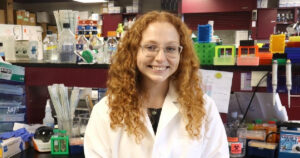
Meet the 2026 Recipient of the EHE Foundation’s Fellowship Travel Grant: Sarah McMullan
Sarah McMullan is a PhD candidate studying epithelioid hemangioendothelioma (EHE) in Dr. John Lamar’s laboratory, in the Department of Molecular and Cellular Physiology at Albany Medical College. This summer, the EHE Foundation awarded her a Fellowship Travel Grant for the second year in a row, allowing her to return to YAP/TAZ and TEAD: At the […]
Retrospective study from Charité–Universitätsmedizin Berlin, Germany
A new retrospective study from Charité–Universitätsmedizin Berlin describes 41 people with EHE treated at the center between 1997 and 2022, offering a single-center picture of EHE presentation and outcomes. It was published in the Journal of Cancer Research and Clinical Oncology in July 2026. In this report, women made up the majority of cases (61%), […]