Why this matters for people with EHE
For people living with EHE, finding an effective treatment and understanding who best benefits from treatments is one of the greatest challenges of this disease. Traditional chemotherapy is often ineffective for EHE, and the search for more effective treatment options is central to our mission at the EHE Foundation. Antibody-drug conjugates, or ADCs, are a promising, emerging strategy in oncology, and understanding how people with EHE might benefit from this rapidly advancing field is a priority for us. A session at ASCO 2026 was dedicated to ADCs in sarcoma, a signal of how quickly this area is moving.
What is an Antibody-Drug Conjugate (ADC)?
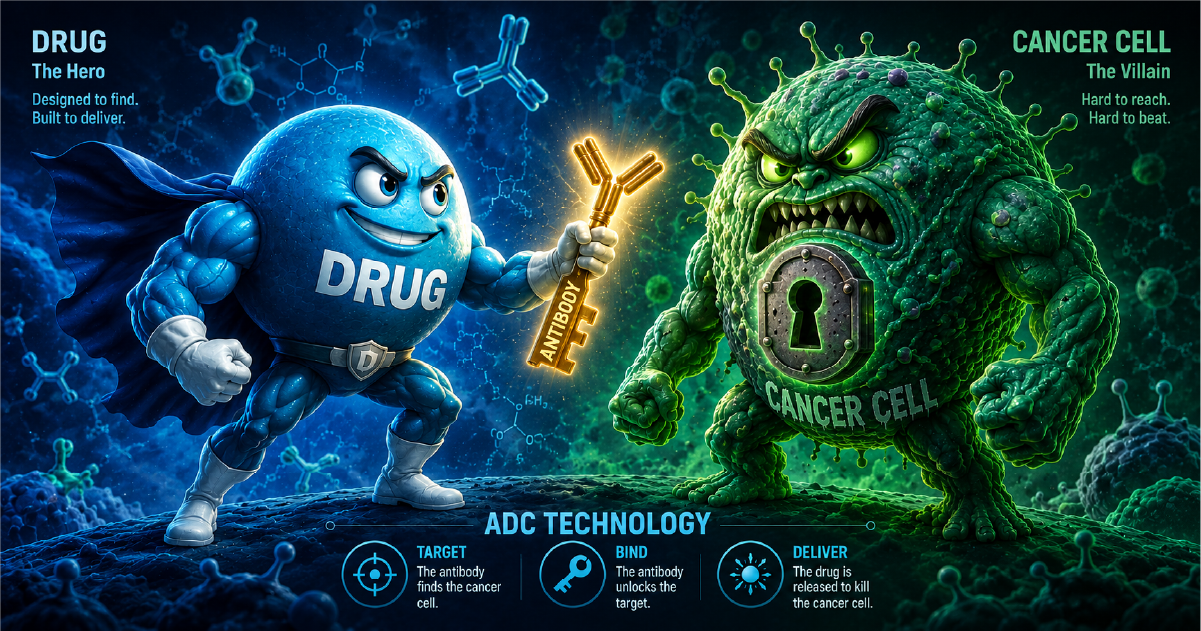
An ADC is a targeted cancer therapy that combines two things: an antibody- a protein that binds to a specific marker on a cell’s surface, like a key in a lock- and a cancer-killing drug. The two are joined by a chemical linker. The goal is to deliver a potent drug directly to cancer cells while sparing healthy tissue.
How do they work?
Once inside the body, the ADC circulates until its antibody “key” finds the matching “lock” on a cancer cell. It latches on, gets pulled inside the cell, releases its drug payload, and destroys the cell from within. Because delivery is targeted, healthy cells are largely spared. In this way, these surface protein “locks” become ADC targets for drug delivery to cancer cells.

How far along is this technology?
The first ADC, Mylotarg® (gemtuzumab ozogamicin), received FDA approval in 2000 for a type of leukemia. Since then, at least 14 ADCs have been approved worldwide, with more than 100 others in clinical trials across a wide range of cancers. Institutions around the world are now studying ADCs at both the preclinical and clinical stages, and the pace of development is accelerating.
In sarcoma, two recent large studies mapped which known ADC targets are expressed across several soft tissue sarcoma subtypes. This lays critical groundwork for understanding where EHE might fit into this landscape.
What are the challenges?
ADC design is complex. Researchers must identify surface proteins (“locks”) that appear on cancer cells but not on healthy cells, and for EHE, that work is still underway. The drug payload, the linker, and the antibody target must all be precisely matched. If the linker releases the drug too early, it leaks into healthy tissue. If the target (“lock”) is not specific enough and is shared with normal cells, healthy tissue is damaged. Cancer cells can also develop resistance by altering their surface markers, effectively changing their “locks”.
Recent work has shown that ADC target expression varies significantly not only between sarcoma subtypes but also within them. For the EHE community, that variability is a direct call to action. Understanding what ADC targets are present in EHE requires s a broadly representative, well-characterized patient population. The EHE Global Patient Registry and the EHE Biobank are tools that we are using to build that foundation of knowledge.
The big picture
ADCs offer meaningful hope for people with EHE. Science is advancing rapidly, and EHE Foundation is working to ensure this community is part of it. Research in soft tissue sarcomas already points to opportunities for combination therapies that pair ADCs with immune checkpoint inhibitors or other targeted agents, potentially improving outcomes beyond what either approach achieves alone. Through the EHE Foundation’s Collaborative Research Network, we are eager to advance research that makes precision medicine, such as ADCs, possible.