TISSUE DONATION IS CRITICAL TO FIND TREATMENTS! Click here to learn more.

We envision a world where Epithelioid Hemangioendothelioma (EHE) is easily diagnosed and treatable. Join our dedicated community by subscribing to our emails.

EMPOWER YOURSELF WITH KNOWLEDGE
Upcoming Foundation Events
Quick Links
Patients
Community
Latest EHE News, Events and Research

Justin Bryan is One Tuff Dude
In October of 2015, Justin Bryan endured a 10-day trek up 19,341 feet of elevation as he scaled the peak of Mount Kilimanjaro in Tanzania. Not too shabby for a man who was told 12 years earlier that he would need to have his leg amputated due to EHE. The year was 2003, and Bryan […]

Texas Hold ‘Em Fundraiser in Memory of Brian Frank
COME OUT & PLAY: TEXAS HOLD’EM FUND RAISER FOR EHE CANCER RESEARCH IN MEMORY OF OUR SO LOVED AND MISSED, ALWAYS IN OUR HEART ……BRIAN FRANK Saturday, August 29 at 12:30pm in PDT 20838 SE 240th St. Maple Valley WA 98038 EHE or Epithelioid Hemangioendothelioma is a extremely rare vascular cancer that only effects 100 people […]

Ava’s Story
Ava is an eight year old girl from Langhorne, PA, where Sesame Place is located. We are about 25 miles from Center City Philadelphia. Ava loves swimming and going to Sesame Place, since it is a water park. Ava loves drawing and takes an Art class on Saturday mornings. She also takes dance class (Hip-Hop) […]

ASCO Talks About EHE
The American Society Clinical Oncologists (ASCO) met in Chicago in May of 2015, for their annual meeting. The theme, Illumination and Innovation: Transforming Data into Learning, aims to improve patient care across the globe through the application of shared knowledge. This is especially important when talking about rare sarcomas. Jane Gutkovich, Vice President of The EHE […]
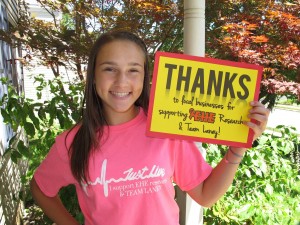
A Night out for EHE Research and Team Laney
On Sunday, July 12, 2015, Ernie’s Irish Pub in Escanaba, MI hosted a fundraiser to raise awareness and funds for EHE Research. It was a big success raising $6,705! It was great fun and the participation and support from the local community and businesses was overwhelming!

Golf Outing to Benefit The EHE Foundation & Cleveland Clinic
Any golfers in the York, Pennsylvania area? Devin O’Connor is hosting a golf tournament to benefit EHE Research this summer. If you don’t golf, come out and enjoy a BBQ dinner, silent auction, and other raffles. Delaney and I are going and we would love to fill a table or two with our EHE family […]
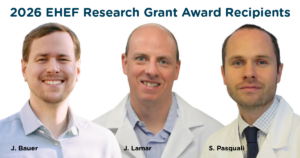
EHE Foundation Awards $335,000 in New Research Grants to Advance Progress in EHE
The EHE Foundation is proud to announce $335,000 in funding through the 2026 EHE Foundation Research Grants Program to support two innovative research projects in epithelioid hemangioendothelioma (EHE). Selected for their scientific merit, potential impact, and clinical relevance, these projects address two important priorities in EHE research: biomarker development and new therapeutic approaches. Together, they […]
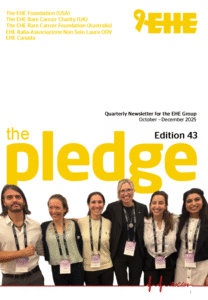
The Pledge: Edition 43, Q4 – October-December, 2025
Publication of The Pledge quarterly newsletter is led by the EHE Rare Cancer Charity (UK). EHE patient advocacy groups from around the globe provide content, including research news, patient and fundraising stories, and much more. Click here to view the most recent edition of the online EHE newsletter, The Pledge.
Understanding Quality of Life for People Living With EHE
The European Organisation of Research and Treatment of Cancer (EORTC) is conducting research to better understand health-related quality of life (HRQoL) concerns among people living with rare cancers. Recently, researchers analyzed results from a group of 31 people with EHE from 11 different countries who participated in the study. The findings showed that pain–and the […]