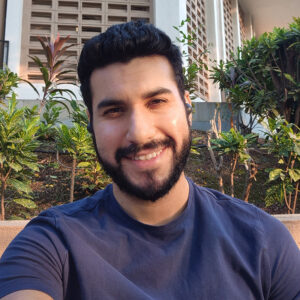
Farzaad’s Story: Facing EHE with Faith, Strength, and Positivity
For Farzaad, the first signs that something was wrong were easy to notice, but impossible to explain.
Around May 2025, he began experiencing swelling in his face that did not feel normal. He also found himself becoming short of breath more easily. Over time, other changes appeared: a strange discoloration on the right side of his chest and bulging veins in his neck. Taken together, the symptoms made one thing clear.
“I knew something wasn’t right,” he said.
In February 2026, a CT scan finally revealed the source of those changes. Doctors found a mass in the center of Farzaad’s chest. It was pressing on the superior vena cava, the major vein that carries blood from the upper body back to the heart. That pressure had begun to block blood flow, causing clots to form in nearby veins and forcing his body to create alternate pathways for circulation. Fluid was also building up around his right lung.
A PET scan soon confirmed that the mass was active and likely cancerous. It also showed that the tumor was affecting the lining around his right lung. At that point, one piece of news brought some relief: there was no evidence that it had spread outside the chest.
After abnormal cells were found in fluid testing, Farzaad underwent a biopsy. A few days later, he had an answer: epithelioid hemangioendothelioma (EHE).
“It was a lot to take in,” he said, “especially because it’s not a common condition and can behave unpredictably.”
At the same time, the pressure on the vein had caused superior vena cava syndrome, or SVC syndrome, which explained the swelling, breathlessness, and other symptoms that had upended his daily life. In early March 2026, Farzaad underwent a procedure to restore blood flow. Doctors removed the clot, widened the blocked area, and placed a stent. The result was immediate and meaningful.
“Thankfully, the procedure was successful, and I felt a noticeable improvement afterward,” he said.
Later that month, additional testing of fluid from around his lungs confirmed that cancer cells were present there, meaning the disease had spread within the chest area. It was another difficult development in a diagnosis that had already changed so much, so quickly.
For Farzaad, one of the hardest parts has been the physical limitation. An athlete and footballer all his life, he suddenly found himself unable to walk or climb the way he once had.
“Not able to climb or walk for a bit has been my lowest,” he shared. “I have been an athlete and footballer all my life, and to have this at 31…”
That unfinished thought says a great deal. A diagnosis like EHE does not only alter scans, treatment plans, or medical routines. It can interrupt identity itself — especially for someone whose life has long been shaped by movement, strength, and physical confidence.
And yet Farzaad’s story is not defined by fear. His positive attitude helps him move forward and battle this rare disease.
That perspective has become a kind of discipline: choosing faith, positivity, and forward motion amid uncertainty.
“Prayers and positivity always,” Farzaad said. “With a smile on my face I am still dealing with it.”
For someone newly diagnosed with EHE, his advice reflects that same mindset. He encourages others to hold onto hope, to stay positive, and to keep going even when the road ahead feels uncertain.
Farzaad’s story is still unfolding. But already, it is a story of endurance — of listening to his body, pursuing answers, facing a rare diagnosis at a young age, and refusing to let fear have the final word.
At 31, Farzaad is navigating a reality he never expected. But even in the face of EHE, he is choosing to meet it with courage, faith, and determination to keep moving forward.