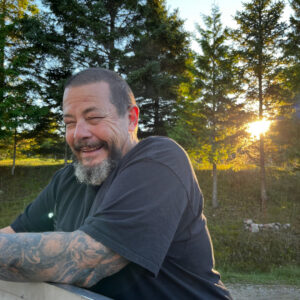
Norm’s Story: A Family’s Love, Search for Answers, and Life After Loss
When Norm went in for a routine health appointment in late 2022, neither he nor his family imagined how quickly life was about to change.
A chest X-ray revealed something concerning in his right lung. Until then, Norm had only noticed what felt like severe heartburn and some mild pain along the side of his chest. There was no clear sign of the devastating diagnosis that was coming.
Further testing followed. An initial biopsy could not reach the area doctors needed, so another procedure was done through his side. At first, the abnormality in his lung was thought to be thickening or scar tissue, possibly from a past pneumonia. But a week before Thanksgiving 2022, Norm and his family received the news: it was epithelioid hemangioendothelioma (EHE).
Within weeks, his pain worsened. Norm was referred to an oncologist in Midland, Michigan, where treatment began, even as his family was still trying to understand a disease few people had heard of, and few clinicians ever encounter. He was started on Votrient in December, while palliative care became central to managing the intense pain caused by tumors in his right lung and pleura.
“The pain my husband was in, and managing it, was an extreme low point,” his wife shared.
Norm was 65 years old. He was a big man, active by nature, and had even undergone a knee replacement the year before. His family knew he was carrying other health burdens, too, but none of that changed what mattered most: he was deeply loved, and they were determined to fight for him.
His wife searched relentlessly for answers. She turned to online EHE support groups, read everything she could find, and pursued consultations at major institutions, including the University of Michigan and Cleveland Clinic. Even as his condition declined, they kept going, hoping for a treatment, a trial, some path forward.
“Up until he passed away, we were looking for answers,” she said.
That search was driven by love, but after Norm’s death, it also became a source of anguish. His wife has had to live with the painful questions that so many caregivers carry after loss: whether more could have been done, whether something should have been seen sooner, whether the truth was softer or harsher than anyone was willing to say out loud.
“Being the caregiver is not easy,” she said. “You question and think about everything you did or what I should have done.”
After five months of worsening pain, urgent appointments, treatment decisions, and desperate hope, Norm died on April 10, 2023.
His wife does not try to reshape the truth of what happened. She tells it plainly.
“I know that is not the story of EHE we want to hear,” she said. “But it is our story.”
There is courage in that honesty. Not every EHE story is one of stabilization or years of watchful waiting. Some are marked by suffering, by unanswered questions, and by the terrible swiftness of advanced disease. Norm’s story is one of those.
And yet it is also a story of devotion.
His wife kept searching, kept asking, kept showing up. She advocated for him in exam rooms, in hospital visits, and across long stretches of uncertainty. She continues to stay connected to the EHE community even now, holding space for others who are still in the fight.
“I continue to stay in Facebook groups for EHE and pray for those who have to deal with this terrible cancer,” she said.
What remains most painful is not only the loss itself, but the sense that more honesty might have changed how those final months were spent. Looking back, she wishes someone had told them more directly how limited time may have been.
“I wish I had known that at the point my husband was in that he was terminal and it wouldn’t be long,” she said. “I would have stopped working and spent every possible second I could have with him.”
That reflection gives Norm’s story a second layer, one that reaches beyond diagnosis and treatment into the lasting experience of grief. EHE does not affect only the person diagnosed. It reshapes entire families. It leaves caregivers carrying memories of pain, decisions, exhaustion, love, and loss long after their loved one is gone.
“It would be nice if there were a group for those left behind,” she said. “Even though our loved one is at peace and free of pain, we are left behind to live with the pain that EHE caused.”
For those newly facing EHE, her advice is immediate and hard-earned:
“Advocate for yourself!!”
Norm’s story is heartbreaking. It is also important. It speaks to the reality that some families encounter EHE only when it is already far advanced. It speaks to the desperate need for clearer guidance, earlier recognition, expert care, honest communication, and support not only for patients, but for the people who love them.
Most of all, it is a story of a deeply loved man and of a wife who did everything she could to find more time for him.