
Treatment Options
How Epithelioid Hemangioendothelioma (EHE) Is Treated and Managed
Treatment for epithelioid hemangioendothelioma (EHE) is highly individualized. People diagnosed with EHE should discuss all management approaches and treatment options with a medical professional experienced in the care and management of sarcoma.
No treatments are approved specifically for EHE, and no single standard of care applies to everyone. Therapeutic approaches may depend on tumor locations, tumor sizes and indications of disease activity, and considering all disease-related symptoms. Based on Experts' Consensus, below are treatment and management approaches that are considered for EHE.
Active Surveillance
Active surveillance, also called "watch and wait," is a disease management approach where patients are closely monitored through imaging, blood tests, and physical exams. This approach may be used to determine if, and what, interventional treatment may be needed to avoid or delay harsh treatments. For people diagnosed with EHE, active surveillance is commonly used and is recommended after diagnosis for asymptomatic patients who are not candidates for surgery, giving doctors time to assess disease progression.
For people diagnosed with EHE, this approach may feel counterintuitive to the natural instinct to take action. Active surveillance is an intentional ongoing process of monitoring the disease. Learn more about how EHE is monitored.
Local Interventions
Local interventions and treatments target tumors in a specific organ or a limited part of the body, rather than the whole body.
Surgery
After a period of observation, surgery is the treatment of choice for single or multiple lesions that are stable or slowly growing and easily accessible. For hepatic tumors, consideration should take into account the anatomical location within the liver, tumor size, number of nodules, any invasion of major blood vessels, and any detected metastatic disease. Surgery is generally recommended only when the tumor can be completely resected with clear surgical margins.
EHE can recur after surgery, sometimes after a prolonged period of time, even when resection was complete. For this reason, long-term regular monitoring and imaging should continue after surgery.
Liver Transplant
Transplantation may be considered when tumors in the liver are unresectable and/or when other local interventions are not recommended. Experts’ consensus is to consider transplantation only when radiological assessment has confirmed that the disease has not metastasized beyond the liver. Limited data exist on the long-term outcomes of liver transplantation, and further studies are needed to understand who may best benefit from transplantation.
Radiation Therapy
Radiation therapy may be used alongside surgery, or as a primary treatment approach when surgery is not possible. It may also be recommended after surgery, known as adjuvant radiation, when surgical margins are narrow or suspected to be positive for disease. Radiation may also be used as a palliative option to relieve symptoms associated with the disease, such as pain.
Locoregional & Ablative Therapies
Locoregional and ablative therapies may be an option to reduce the burden of disease for unresectable tumors or metastatic disease.
- Stereotactic body radiation therapy (SBRT) delivers precise, targeted, high-dose radiation to a tumor over a series of treatment sessions.
- Radiofrequency ablation (RFA) uses a needle-like probe to deliver high-frequency radio waves that heat and destroy tumor tissue.
- Microwave ablation (MWA) is a minimally invasive procedure that uses high-frequency electromagnetic waves to generate heat and destroy tumor tissue.
- Transarterial chemoembolization (TACE) delivers chemotherapy directly into the blood vessels feeding a liver tumor to block its blood supply, starving the tumor while leaving healthy liver tissue unharmed.
- Selective internal radiation therapy (SIRT), also called radioembolization, delivers radioactive particles directly into the blood vessels feeding a tumor.
- Isolated limb perfusion (ILP) temporarily isolates blood flow to an arm or leg and delivers high-dose chemotherapy directly to that limb.
- Irreversible electroporation (IRE) is a non-thermal ablation technique that uses short, high-voltage electrical pulses to destroy tumor tissue. Watch Dr. Govindarajan ‘Raj’ Narayanan’s presentation from the 2025 EHE Global Conference, "IRE in the Management of Hepatic Epithelioid Hemangioendothelioma".
- Histotripsy is a non-invasive technique that uses focused sound waves to mechanically destroy tumor tissue. Watch Drs. Wang, Shyn, and Wagner’s presentation from an EHE 360 Connect webinar in October 2025, "Exploring Histotripsy as a Treatment Option for EHE".
Systemic Therapies
Systemic therapy uses medication that travels through the bloodstream to reach cancer cells throughout the body. It's recommended for EHE when there is clear evidence of disease progression, worsening symptoms, or organ dysfunction.
For people with metastatic EHE who have no signs or symptoms of worsening disease, and for whom surgery is not possible without complications, a period of active surveillance is recommended first, to avoid overtreatment.
Although several systemic agents are approved to treat sarcomas broadly, none are currently approved specifically for EHE. Several drug classes have been used, or are currently being studied, as potential treatments for EHE:
- mTOR inhibitors: sirolimus, everolimus, and temsirolimus
- Multi-tyrosine kinase inhibitors (TKIs): pazopanib, sunitinib, and sorafenib.
- MEK inhibitor: trametinib
- Conventional chemotherapy: doxorubicin, paclitaxel, docetaxel, and eribulin. Cytotoxic chemotherapy used for other soft tissue sarcomas has limited activity in EHE and is generally reserved to treat more aggressive disease.
- Interferon, Interferon alpha-2B
- TEAD inhibitors: a newer class of drugs currently being studied in early-stage clinical trials.
Clinical Trials
Clinical trials are an important consideration as a treatment option for people with advanced or progressing EHE. For some people, a clinical trial of a novel drug may be the only viable treatment option. Consult with your physician to address any questions you may have.
Learn more about clinical trials for people with EHE.
Palliative Care & Pain Management
Interdisciplinary palliative care is recommended as an integral part of care for people with EHE to support clinical symptoms, such as pain, and psychosocial support needs. Pain related to EHE is one of the most commonly reported symptoms in people with advanced or progressing disease. EHE-related pain may be challenging to control, and personalized approaches are recommended. Early referral to palliative care and pain management may support better quality of life for people with EHE.
Learn more about managing pain with EHE.
Experts’ Consensus on EHE
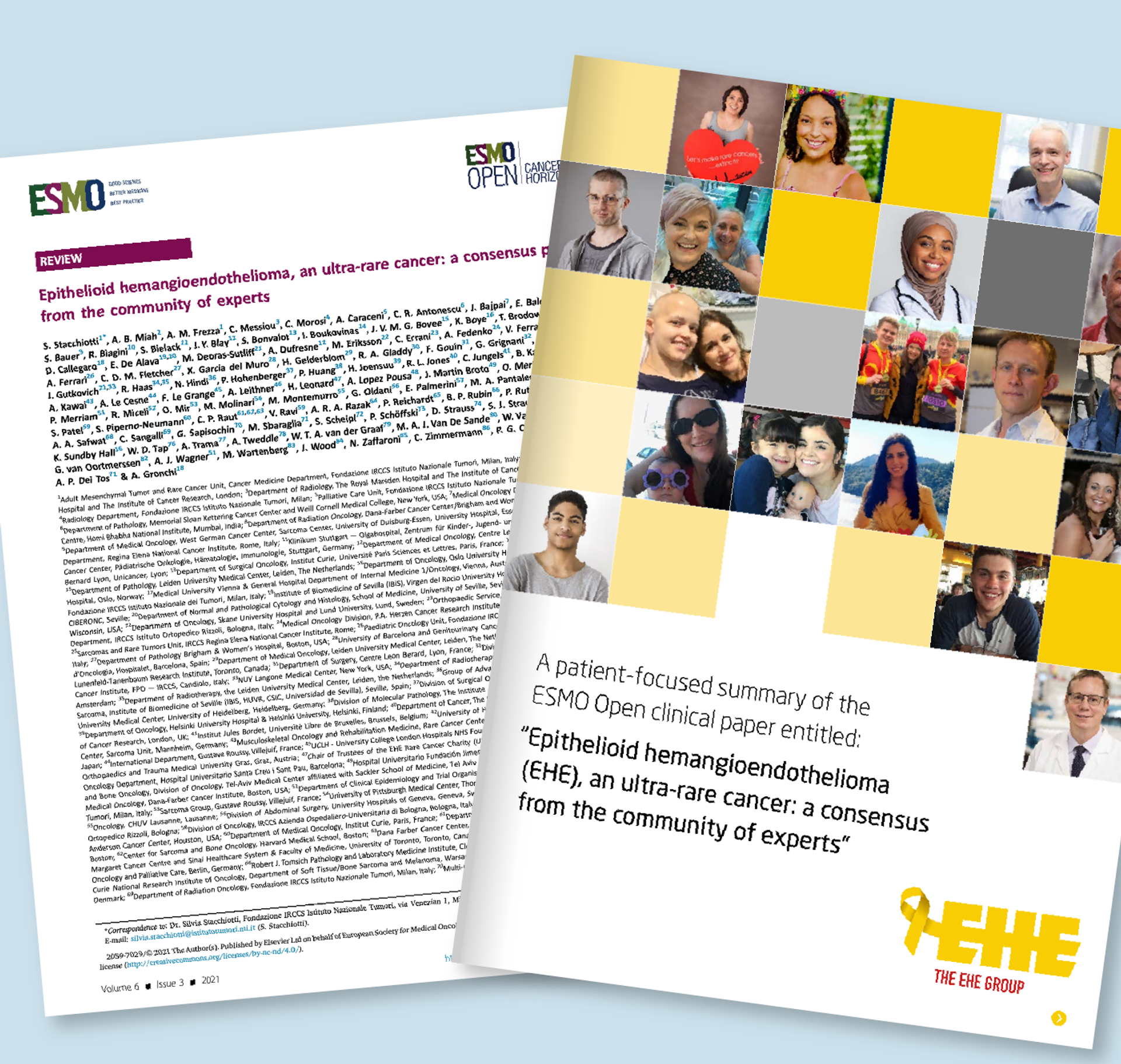
An international group of experts outlines disease biology, pathology, clinical presentation, and general principles of EHE management in the Experts’ Consensus Paper on EHE Management. Written to guide clinicians caring for people with EHE, the paper reflects current evidence and shared clinical experience across global EHE centers.
A patient-friendly version was developed to help people diagnosed with EHE understand the principles that shape care decisions. This foundational resource is a must-read for anyone affected by EHE and supports informed care planning and shared decision-making.
Video Resources


Continue Learning
Imaging plays a role at every stage of EHE, from initial assessment to monitoring the disease over time.