Clinical Presentations of EHE
EHE is an ultra-rare vascular sarcoma with an estimated incidence of 3.8 cases per 10,000,000 people per year. The total number of people living with EHE is estimated to be fewer than 1 per million people.
- EHE is slightly more common in women than men
- EHE is very rare in children
EHE tumors can present anywhere in the body, and most commonly are found in the liver, lungs, and bones, and the disease is often metastatic at the time of diagnosis.
EHE has a highly variable clinical course and can behave unpredictably. For some people, the disease may remain stable or grow slowly over a long time, with only subtle signs if/when it shifts to a more progressive or aggressive form. Presentation at diagnosis can be highly variable. In some cases, the disease may be found incidentally during a medical examination for another purpose and does not cause any symptoms (asymptomatic). Some patients present with progressive disease and widespread symptoms such as:
- Pain - the most commonly reported symptom
- Palpable mass
- Weight loss
- Fever
- Fatigue
- Shortness of breath
Molecular Biology & Pathology
Molecular confirmation of an EHE diagnosis by an expert pathologist at a sarcoma reference center is strongly encouraged. Molecular assessment may be performed to detect the WWTR1-CAMTA1 or YAP1-TFE3 gene fusions. Immunohistochemical (IHC) staining should be performed to assess for differential markers including CAMTA1, CD31, ERG, CD34, and FLI-1. These markers of disease help distinguish EHE from other cancers. A confirmed diagnosis is an important step to inform the treatment plan.
Differential Diagnoses
Expert pathological assessment is strongly recommended to confirm an EHE diagnosis. Some diseases, such as angiosarcoma, may be misdiagnosed as EHE. Some diseases have names that are similar to EHE but are very different. It is important to recognize diseases like epithelioid sarcoma, epithelioid angiosarcoma, and other hemangioendotheliomas that are not EHE.
Localized and Multifocal Disease
EHE may present as a single lesion (i.e., tumor), or as multiple lesions. Multifocal EHE, involving two or more separate sites of disease within the same organ or tissue area, is common, particularly in the lungs and liver.
Metastatic Disease
EHE is often metastatic at clinical presentation. The behavior of metastatic EHE can range from indolent, where tumors are stable to very slowly growing, to aggressive disease with the presence of EHE-related signs and symptoms and/or rapid growth. For people with metastatic EHE who have no signs or symptoms of worsening disease, and where surgery is not possible, a period of active surveillance is often recommended as an initial strategy to avoid overtreatment. New or worsening symptoms, such as fever unrelated to infection, weight loss, pain, and/or fatigue, may correlate with a worse quality of life and prognosis. Patients and clinicians should monitor and discuss any changes in suspected disease-related symptoms as part of an active care plan.
Thoracic EHE
Thoracic EHE can present with four main patterns: multiple small pulmonary (lung) nodules, reticulonodular opacities, thickening of the pleura (lining of the lungs), or a single mass in the lung. Sometimes pulmonary nodules may exhibit a surrounding halo, so-called ground glass opacity. Patients with diffuse pleural thickening and pleural effusion seem to have a poor prognosis. Worsening of symptoms, with or without changes on scans, should be carefully considered as a potential sign of disease progression.
Pleural Effusion and Ascites
EHE involving the pleura, or lining of the lungs, with fluid around the lungs has been shown to be associated with more aggressive disease and a worse prognosis. Clinicians should closely assess for the presence of pleural fluid or ascites (fluid in the abdominal cavity) to predict the disease course and treatment strategy.
EHE in Bones
When EHE involves bones, the axial skeleton (including the skull, vertebral column, and thoracic or rib cage) and lower limbs are the most common sites.
Pregnancy and EHE
There are no data available to understand the effect of pregnancy on the course of EHE. Ongoing studies are investigating the role of hormones in EHE. Additional research is needed.
Disease Staging & Prognosis
EHE is not staged using the standardized I-IV staging system used for other common cancers. Currently, there are no validated pathological or molecular factors to determine a person’s prognosis. Experts use a combination of factors, including disease spread (metastasis), tumor size and mitotic activity, and the presence of systemic signs and symptoms. EHE has a highly variable and unpredictable disease course, and prognosis may vary widely among individuals.
Experts’ Consensus on EHE
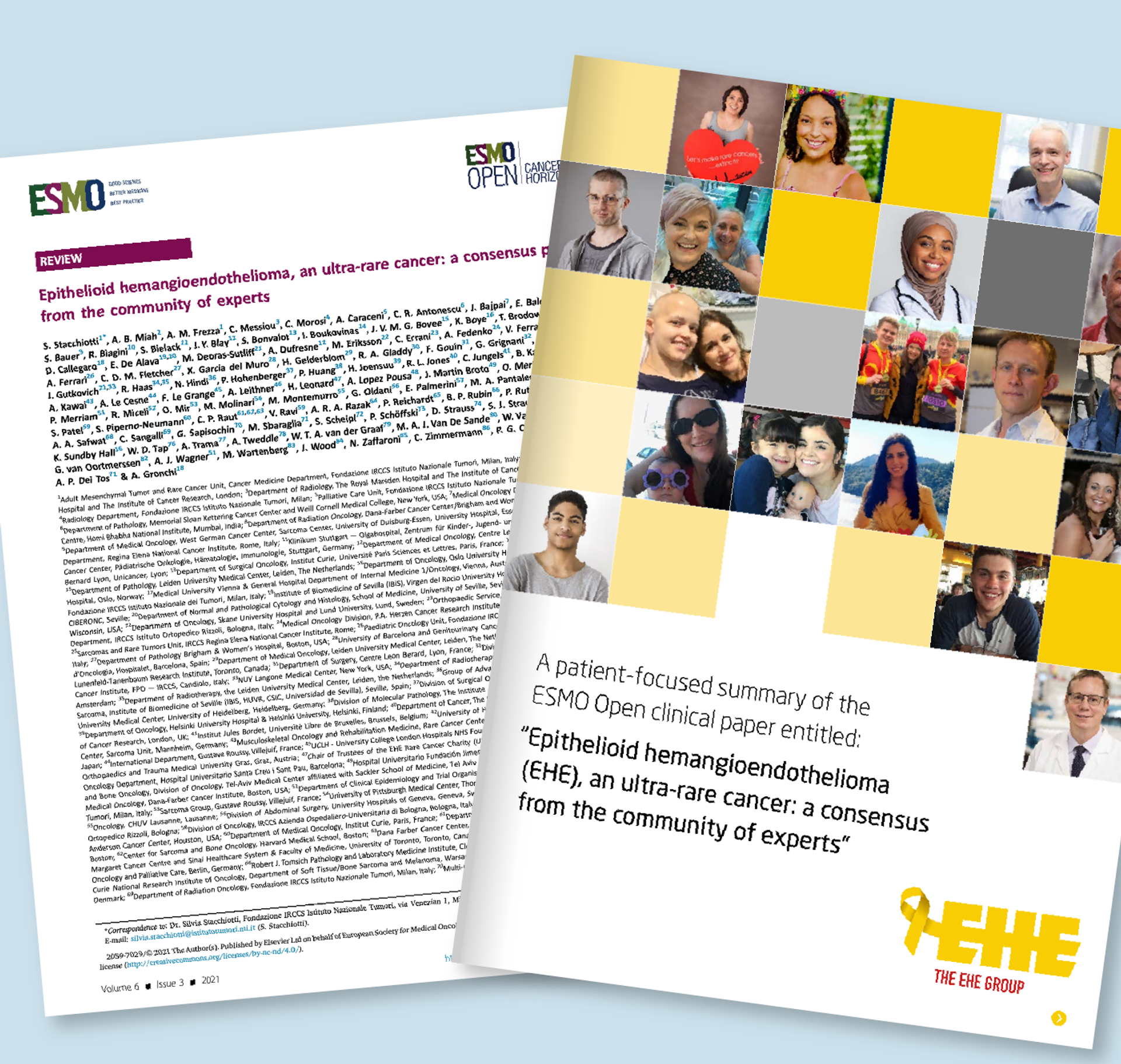
An international group of experts outlines disease biology, pathology, clinical presentation, and general principles of EHE management in the Experts’ Consensus Paper on EHE Management. Written to guide clinicians caring for people with EHE, the paper reflects current evidence and shared clinical experience across global EHE centers.
A patient-friendly version was developed to help people diagnosed with EHE understand the principles that shape care decisions. This foundational resource is a must-read for anyone affected by EHE and supports informed care planning and shared decision-making.