Published on: March 30, 2026
Categorized as: Investing in Discovery
Lamar Lab | Albany Medical Center
Investing In Discovery
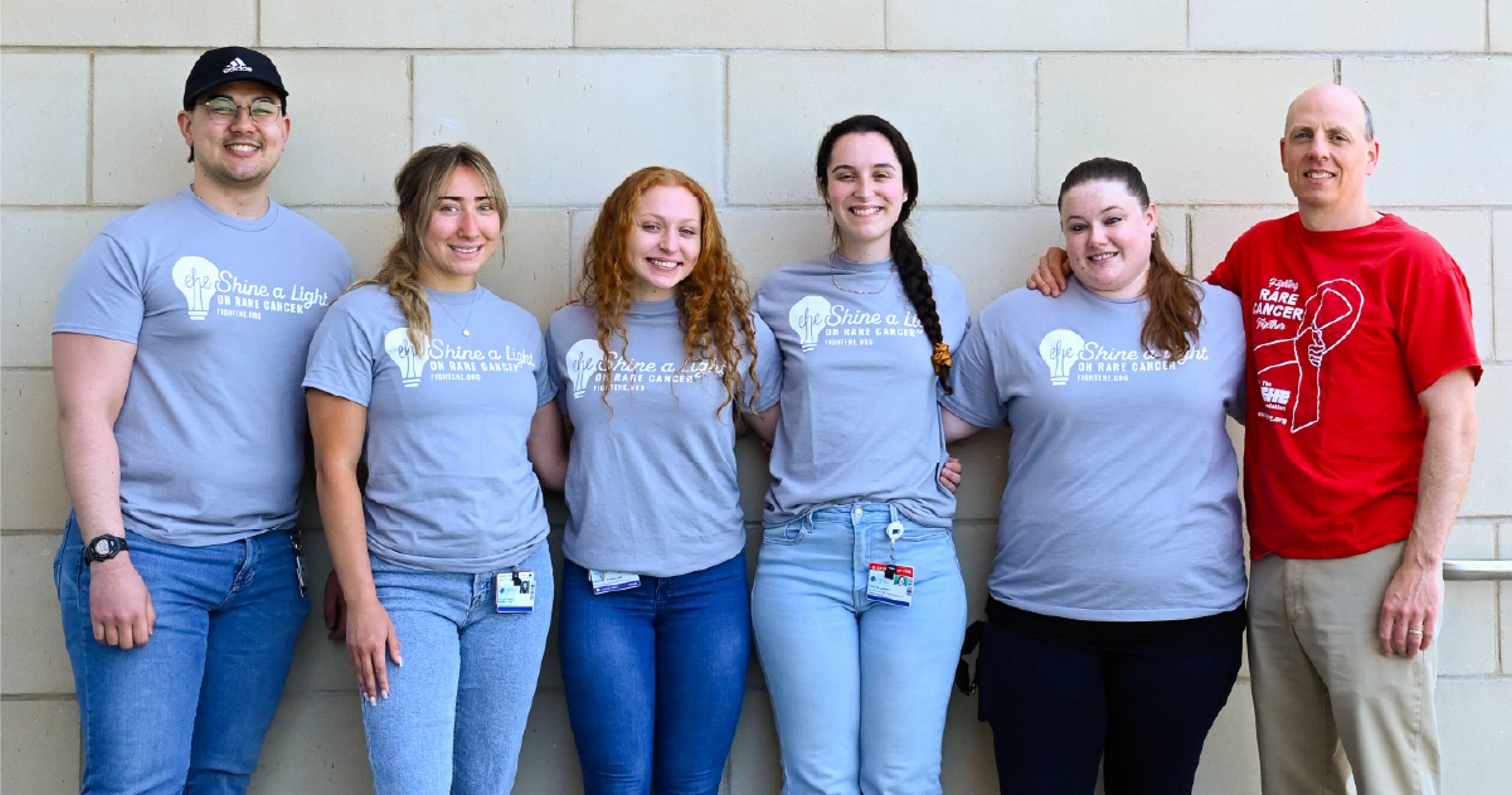
The Lamar Lab is led by John Lamar, PhD, associate professor of Molecular and Cellular Physiology at Albany Medical College. The growth of EHE research in the Lamar Lab reflects Dr. Lamar’s commitment to collaboration, open science, and helping patients. The EHE Foundation, alongside our global EHE advocacy partners, has invested in innovative basic and translational research that has deepened our knowledge.
Projects funded by the EHE Foundation in the Lamar Lab include:
"Identification of TAZ-CAMTA1 Regulators"
Funded in 2019 in partnership with the EHE Rare Cancer Charity (UK) and the EHE Rare Cancer Foundation Australia, this proof-of-concept study aimed to test the hypothesis that the TAZ-CAMTA1 fusion protein is subject to regulation by Hippo-pathway-independent mechanisms that could be exploited to inhibit TAZ-CAMTA1 function and treat EHE. The goal was to find proteins that regulate the TAZ-CAMTA1 fusion protein, with an eye toward eventually blocking it without disturbing normal YAP and TAZ function elsewhere in the body.
"TAZ-CAMTA1 Regulation by the Calcium Sensor Calmodulin"
Building on findings from prior research, the EHE Foundation, in partnership with the EHE Rare Cancer Foundation Australia, awarded a 3-year grant in 2021 to investigate if a protein called Calmodulin (CaM) can repress the oncogenic activity of the TAZ-CAMTA1 fusion protein that plays a causal role in more than 90% of all EHE.
The hypothesis was that CaM binds to the TAZ-CAMTA1 fusion protein and blocks its importation into the nucleus, where it would normally bind to TEADs and promote the expression of other genes that are necessary for the survival and growth of EHE cells. Initially, the project proposed to use fibroblasts expressing TAZ-CAMTA1 to study CaM because there were no EHE cell lines available. However, EHE cell lines were established during the course of this project in the Rubin Lab.
The initial results found that CaM and TAZ-CAMTA1 co-localize in the cytoplasm, but not the nucleus, of EHE cells. This is consistent with their hypothesis that CaM binds to TAZ-CAMTA1 in the cytoplasm and prevents it from entering the nucleus. However, although CaM is expressed in all cells, the initial work suggests that the amount of CaM produced by EHE cells is not sufficient to prevent most of the TAZ-CAMTA1 from entering the nucleus. This is why CaM is not able to prevent EHE formation and growth in cells that have a TAZ-CAMTA1 fusion.
Dr. Lamar predicts that if they can increase CaM expression in EHE cells or treat EHE cells with a peptide that “mimics” CaM, it will reduce the amount of TAZ-CAMTA1 in the nucleus and inhibit its function.
"Use of Pre-clinical EHE Models to Identify Druggable Pathways to Treat EHE."
The EHE Foundation awarded the Lamar Lab a three-year grant in 2022 to identify druggable pathways to treat EHE. The strategy was practical: rather than developing a new drug from scratch, an enormous undertaking for an ultra-rare cancer, the lab would screen already FDA-approved drugs for their ability to block EHE cell growth, so that any promising hit could move toward the clinic faster.
The Lamar Lab tested a large panel of drugs and found 17 that blocked EHE cell growth and survival. Narrowing to candidates that spared healthy cells left five, and four of those were statins, the widely prescribed cholesterol-lowering drugs. Follow-up work showed statins reduce EHE cell growth and survival not through cholesterol lowering but by blocking an enzyme needed to activate Ras-GTPase proteins, and the finding held up in human EHE cells as well as the lab's mouse-derived lines.
That statin work, along with a related project on “AMP-activated protein kinase (AMPK),” was published in September 2025 in Cancers, led by Ryan Kanai, PhD. The AMPK study found that activating AMPK slows EHE cell growth through two mechanisms at once: by increasing TAZ-CAMTA1 activity to a level the cells cannot tolerate, and by shutting down the mTOR signaling pathway, adding new mechanistic support for the existing use of the mTOR inhibitor sirolimus in EHE.
"Biomarker Discovery in Epithelioid Hemangioendothelioma"
Most recently, in its 2025 grant cycle, the EHE Foundation awarded the Lamar Lab and international collaborator Sandro Pasquali, MD, PhD, of the Fondazione IRCCS Istituto Nazionale dei Tumori in Italy, a two-year project that aims to identify biomarkers of EHE.
This project addresses a high unmet need: how to reliably monitor EHE progression or response to treatment. Without adequate, non-invasive disease-monitoring strategies, people and their doctors face difficult decisions about whether to start or change treatments.
The project will use technology that labels and captures proteins released by EHE cells into the bloodstream, testing candidate biomarkers in preclinical models and in samples from people with EHE, with the goal of building a blood test that can catch disease progression earlier.
From YAP/TAZ to EHE
Dr. Lamar's path to EHE began with a broader interest in two proteins, YAP and TAZ, and their role in metastatic breast cancer and melanoma. In 2017, that work led him to Dr. Guy Weinberg, an anesthesiologist and researcher who had founded a small workshop to introduce EHE to leaders in the YAP/TAZ field. EHE is driven almost entirely by a single genetic event, a chromosomal translocation that fuses the TAZ and CAMTA1 genes (found in more than 90% of cases) or, less commonly, YAP and TFE3. That feature made EHE an unusually clean model for studying YAP/TAZ biology, and it drew Dr. Lamar into the field. The workshop, "YAP/TAZ and TEAD: At the Crossroads of Cancer," still runs annually in Telluride, Colorado, and the two now co-direct it together.
Publications

AMPK Signaling Regulates Epithelioid Hemangioendothelioma Cell Growth
Kanai R, McMullan S, Baniya P, et al. "AMPK Signaling Regulates Epithelioid Hemangioendothelioma Cell Growth." Cancers (Basel). 2025;17(17):2889.
The Telluride YAP/TAZ and TEAD Workshop: A Small Meeting with a Big Impact
Weinberg GL, Salamon P, Lamar JM. "The Telluride YAP/TAZ and TEAD Workshop: A Small Meeting with a Big Impact." Cancers (Basel). 2023;15(19):4717.
Loss of CDKN2A Cooperates with WWTR1(TAZ)-CAMTA1 Gene Fusion to Promote Tumor Progression in Epithelioid Hemangioendothelioma
Seavey CN, Hallett A, Li S, et al. "Loss of CDKN2A Cooperates with WWTR1(TAZ)-CAMTA1 Gene Fusion to Promote Tumor Progression in Epithelioid Hemangioendothelioma." Clin Cancer Res. 2023;29(13):2480-2493.
WWTR1(TAZ)- CAMTA1 gene fusion is sufficient to dysregulate YAP/TAZ signaling and drive epithelioid hemangioendothelioma tumorigenesis
Seavey CN, Pobbati AV, Hallett A, et al. "WWTR1(TAZ)-CAMTA1 gene fusion is sufficient to dysregulate YAP/TAZ signaling and drive epithelioid hemangioendothelioma tumorigenesis." Genes Dev. 2021;35(7-8):512-527.
Further Reading:
- EHE Research Grants – Your Support Makes a Big Impact
- Research Grants Program (funded projects by year)
- EHE Foundation Awards $335,000 in New Research Grants to Advance Progress in EHE
- Preclinical Evidence Supporting the Therapeutic Potential of Statins in EHE
- New Study Uncovers Unexpected Role for AMPK in EHE
- Supporting the Next Generation of EHE Researchers: Sarah McMullan of the Lamar Lab Attends International YAP/TAZ Workshop
- Meet the 2026 Recipient of the EHE Foundation’s Fellowship Travel Grant: Sarah McMullan
- The Lamar Lab: Harnessing the Therapeutic Potential of the Hippo Pathway in EHE
- Research at Albany Medical College Brings Attention to Rare Cancer, Albany Med Health System (Dec. 20, 2022)
- John M. Lamar, PhD – Researcher Profile, Albany Medical College